

Few cities in the world compress so much visual ambition into walkable distances. Milan is one of them. The streets between the Duomo and Brera read like an open-air museum of taste, where Renaissance courtyards sit beside mid-century showrooms, and a single block can take you from Gothic spires to minimalist glass facades. For anyone with an eye for design, this city rewards slow walking more than quick sightseeing.
The challenge, as any returning visitor knows, is not finding beautiful things to look at. It is managing the day well enough to actually see them. Heavy bags, tight metro schedules, and the temptation to stop in every boutique on Via della Spiga can quietly derail even the best intentions. With a bit of planning, though, Milan rewards those who move through it freely, without the weight of luggage in hand.
Starting at Milan Centrale: The Architecture of Arrival
Milan Centrale is not just a transport hub. It is one of the most theatrically designed train stations in Europe. Completed in 1931, its monumental facade blends Art Nouveau detail with Fascist rationalism, crowned by reliefs, eagles, and vast stone arches that dwarf every arrival. Spend ten minutes outside before entering. The interplay of scale and ornament is a deliberate statement about the city you are entering.
For visitors arriving by train, the station is the natural starting point of any luggage storage in Milan itinerary. Before beginning the walk toward the Duomo, it makes sense to lighten the load entirely. The luggage storage by Milan Centrale offered by Baggy Lockers lets you deposit bags securely and pick them up at any time, freeing you to move through the city the way it deserves to be experienced: both hands free, camera ready, unhurried. The difference between dragging a wheeled suitcase across the cobblestones of Brera and walking the same streets unencumbered is not a minor one.
From Centrale to the Duomo: The Corso Buenos Aires Corridor
The walk south from Milan Centrale toward the centre passes through one of the city’s densest retail corridors, Corso Buenos Aires, a long straight stretch lined with affordable fashion chains, independent concept stores, and the occasional unexpected gallery. It is not the glamorous Milan of the fashion magazines, but it is the Milan that most people actually live in, and it has a visual energy of its own.
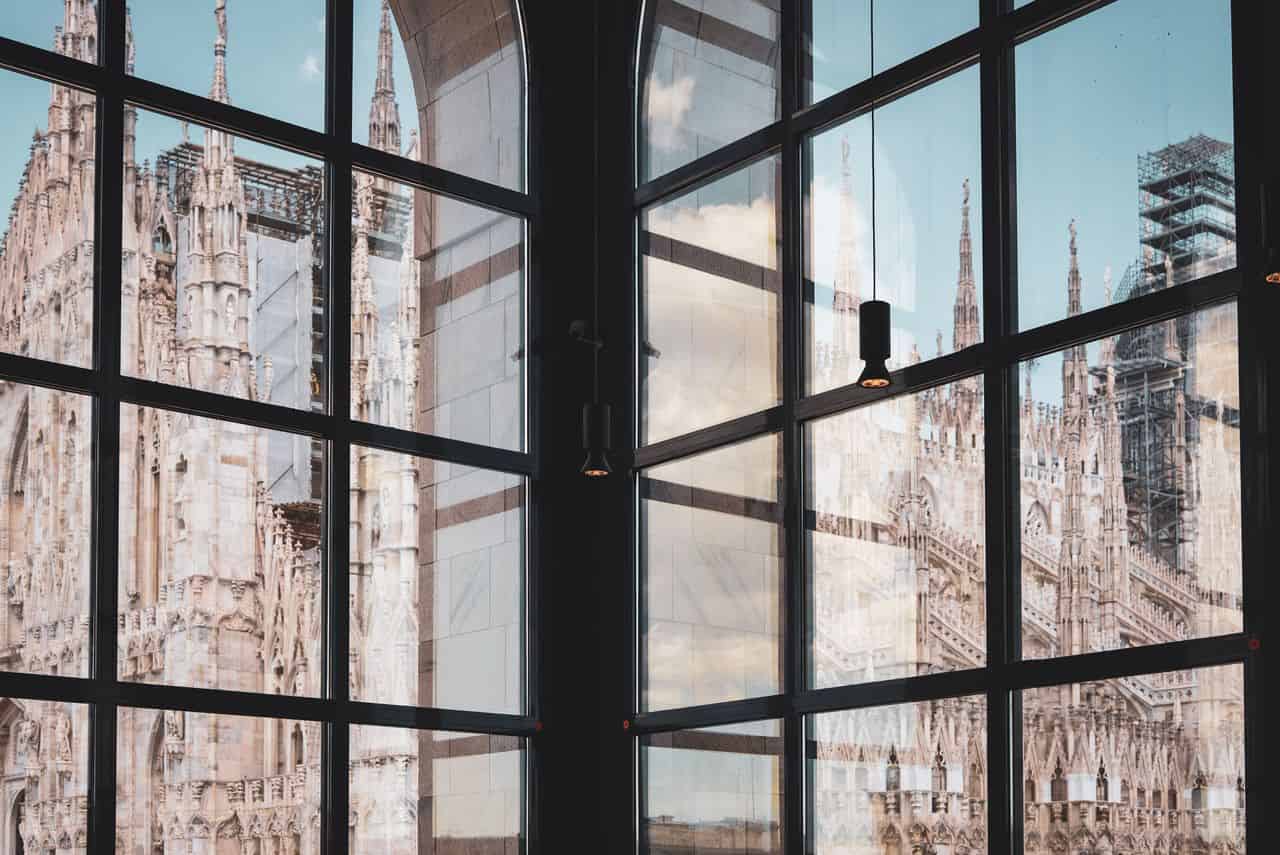
From Piazza Venezia, the city opens up as you approach Piazza del Duomo. The cathedral itself, a Gothic project that took nearly six centuries to complete, is the single most photographed building in Italy after the Colosseum. What photographs never quite convey is the density of its surface: more than 3,400 statues, 135 gargoyles, and 52 exterior pillars. If architecture is the subject, the rooftop walk is mandatory. From the marble terraces you look across the city’s roofline toward the Alps on a clear day, with the Madonnina gilded statue rising directly above.
Adjacent to the Duomo, the Galleria Vittorio Emanuele II deserves more than the few minutes most visitors give it. Built between 1865 and 1877, it is among the oldest shopping galleries in Europe, and its iron-and-glass vaulted ceiling remains a high point of 19th-century engineering. The floor mosaics represent the coats of arms of Italy’s four capital cities. The tradition of spinning on the bull mosaic from Turin is harmless folklore, but the architecture above it is the real reason to linger.
Brera: The Neighbourhood That Defines Milan’s Creative Identity
A 15-minute walk north from the Duomo brings you into a different Milan. Brera began building its reputation in 1776 when Empress Maria Theresa of Austria commissioned the Academy of Fine Arts on Via Brera, establishing the neighbourhood as a gathering point for artists, architects, and intellectuals that it has remained ever since. The Pinacoteca di Brera, housed in the same palazzo, holds one of Italy’s finest collections of northern Italian painting, including Mantegna’s arresting Lamentation of Christ.
Beyond the gallery, the neighbourhood is best experienced as a slow walk rather than a checklist. Via Fiori Chiari and Via Madonnina are the streets to prioritise: cobblestoned, narrow, lined with antique shops, independent boutiques, and design showrooms that do not announce themselves loudly. Palazzo Citterio on Via Brera is worth noting for its 18th-century facade; so is the courtyard behind the Academy, where the pace slows and the city noise drops. During April’s Fuorisalone design week, the entire district transforms into an outdoor exhibition space, with courtyards and studios opening to the public and international brands launching collections in unexpected venues. The rest of the year it is quieter, and arguably more interesting for it.
The Shopping Quadrilateral: Fashion as Architecture
East of Brera, the Quadrilatero della Moda, the fashion district anchored by Via Montenapoleone, Via della Spiga, Via Sant’Andrea, and Via Manzoni, operates at a different frequency. This is where the major international houses have their flagship stores, and the design of each interior is often as considered as anything in a gallery. Prada, Versace, Armani, and Dolce & Gabbana have each used their Via della Spiga or Montenapoleone addresses as architectural statements, commissioning interiors that say something specific about the brand’s identity.
Even without spending, the Quadrilatero rewards careful attention. Window displays during the fashion seasons reach a level of visual sophistication that is genuinely worth studying, and the fabric of the buildings themselves, many dating from the 18th and 19th centuries, provides a backdrop that no new-build shopping district can replicate. The neighbourhood is also compact enough to cross entirely on foot in under twenty minutes, which makes it a natural end to a day that started at Centrale and moved through the centre.
Moving Through the City Without the Weight
Milan is not Rome. The distances are manageable, the streets are flat, and the public transport is reliable. What slows most visitors down is not the geography but the logistics: checking luggage at the hotel, returning to collect bags before an evening train, or navigating the metro with a full backpack during rush hour.
The smarter approach is to leave bags in luggage storage near the arrival or departure point and collect them only when needed. That habit also fits how the city has been changing. Since 2018 Milan has converted roughly 56,000 square metres of road space into pedestrian areas through its Piazze Aperte programme, around sixty interventions in total, as documented in this European Commission case study on the city’s tactical urbanism. The centre keeps getting better for anyone on foot. Excellent news, unless you are the one dragging a hard-shell trolley across a resurfaced square at eleven in the morning. Walk the route unencumbered and Milan gives back more than it asks.
A Note on Timing
Milan’s fashion and design calendar has its own logic. Fashion Week in February and September and Design Week in April are the moments when the city is most alive creatively, but also most crowded and most expensive. Outside these windows, particularly in October and November, the city offers the same architecture and the same neighbourhoods at a considerably more relaxed pace. The light in late autumn is also, for photographers, the most flattering the city gets.
Whenever you go, the itinerary holds. Centrale, the Duomo, the Galleria, Brera, the Quadrilatero: this is a route that moves through Milan’s layers of design and fashion in sequence, from the monumental to the intimate, from public spectacle to a quiet courtyard with a coffee. Start light, walk slowly, and save the shopping decisions for after the architecture has had its proper due.